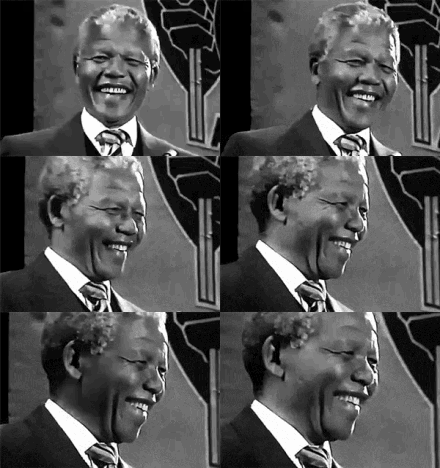
Primer: Why Nelson Still Matters
Mandela archetypes absorb personal cost to unite rival factions. You model forgiveness without erasing accountability, and you reframe justice as a shared future rather than a zero-sum fight. People follow because you offer both hope and structure. This Q&A brief distills biography, operating system, and modern applications so readers can deploy the archetype with confidence.
Core Pillars
- Centers empathy even in high-conflict environments
- Earns trust across diverse communities
- Models forgiveness without losing accountability
- Converts lived experience into moral authority
Watchouts
- May carry burdens quietly, risking burnout
- Forgiveness can be misread as leniency
- Relies on patience when urgent change is demanded
- Struggles delegating conflict-heavy tasks
Leadership Snapshot
Mandela made reconciliation feel as rigorous as a military campaign, pairing empathy with institutional guardrails.
- Born: 1918 — Mvezo, South Africa
- Died: 2013 — Johannesburg
- Role: President, Republic of South Africa (1994-1999)
- Specialty: Legitimacy-building through forgiveness plus accountability
Deployment Zones
Use the Nelson archetype when you need:
- Restorative justice
- civic leadership
- DEI strategy
- community mediation
- social entrepreneurship
Signature Timeline & Campaign Pulse
Five anchor moments that prove why Nelson Mandela still trends in boardroom decks.
- Co-founds the ANC Youth League, arguing for disciplined mass action.
- Faces Treason Trial; learns courtroom tactics that later frame constitutional talks.
- Sentenced to life at Rivonia; speech from the dock becomes a rallying manifesto.
- Walks free from Victor Verster Prison and immediately calls for calm, not revenge.
- Elected president; launches TRC and national service programs for shared prosperity.
Battlefield-to-Bureaucracy Playbook
Stack these cards into strategy briefs, leadership workshops, or culture resets.
Campaign Stack
- Centers empathy even in high-conflict environments
- Earns trust across diverse communities
- Models forgiveness without losing accountability
Coalition Stack
- Converts lived experience into moral authority
- Builds inclusive narratives that heal divisions
Stability Stack
- Counter-risk: May carry burdens quietly, risking burnout
- Counter-risk: Forgiveness can be misread as leniency
- Counter-risk: Relies on patience when urgent change is demanded
Truth & Reconciliation Commission
Mandela insisted that confession be paired with amnesty hearings broadcast nationwide. Victims spoke before perpetrators, forcing the country to witness trauma before debating policy.
The structure inspired modern corporate restorative programs: independent chairs, transparent transcripts, and published recommendations tied to budgets.
Resentment is like drinking poison and then hoping it will kill your enemies.
— Nelson Mandela, 1995 interview
Comparative Scorecard
Benchmark Nelson against an operator (Augustus) and a reconciler (Nelson Mandela) to anchor strategic debates.
| Signal | Nelson Mandela | Augustus | Nelson Mandela |
|---|---|---|---|
| Signature Play | Turns moral authority into cross-party compacts without weaponizing shame. | Turns civil turmoil into lasting institutions and codified incentives. | Uses reconciliation and moral authority to reset the rules of engagement. |
| Coalition Style | Insists adversaries share ceremonies, security details, and rugby finals to humanize each other. | Stitches elites, army, and provinces through calibrated power-sharing and ritual. | Centers empathy, ritual, and accountability to unite rivals. |
| Risk Trigger | Self-sacrifice can hide fatigue; bad actors exploit his patience unless allies enforce guardrails. | Can drift toward caution, requiring fresh catalysts to avoid stagnation. | Patience can frustrate urgent reformers and invite bad actors if guardrails slip. |
| Cultural Legacy | Embeds Ubuntu into policing, education, and public broadcasting to normalize dignity. | Builds civic religion, infrastructure, and law to keep Rome cohesive. | Models forgiveness, civic dignity, and inclusive nation-building. |
| Modern Takeaway | Lead with forgiveness but budget for enforcement so optimism survives bad news. | Systems outlive charisma when you reward compliance and deliver calm. | Lead with dignity but protect your own stamina and safety nets. |
Research Toolkit & Further Reading
Blend primary sources, documentaries, and Zinvana explainers for instant topical authority.
-
Memoir
Long Walk to Freedom
Mandela's autobiography doubles as a playbook for principled resilience.
-
Archive
ANC Digital Archives
Speeches, posters, and underground newsletters to quote when mapping coalition work.
-
TRC
Justice.gov.za transcripts
Searchable testimony database for compliance, HR, and civic lessons.
-
Documentary
Frontline: The Long Walk of Nelson Mandela
PBS special with interviews from prison warders, comrades, and negotiators.
-
Guide
Zinvana: Mandela Profile
Companion visuals, quotes, and archetype fit worksheet.
In-Depth Q&A – Ten Expert Answers
Tap a topic to expand; each badge tells you which strategic lane you are exploring.
What early conditions shaped Nelson Mandela's leadership instincts? Origins
Mandela archetypes absorb personal cost to unite rival factions. You model forgiveness without erasing accountability, and you reframe justice as a shared future rather than a zero-sum fight. People follow because you offer both hope and structure.
How does Nelson Mandela keep momentum without losing control? Strategy
Centers empathy even in high-conflict environments Earns trust across diverse communities Models forgiveness without losing accountability
What systems make Nelson Mandela's leadership sustainable? Systems
Restorative justice, civic leadership, DEI strategy, community mediation, social entrepreneurship
How does Nelson Mandela hold coalitions together? Allies
You need partners who protect your energy and share responsibility for care. Mutual vulnerability keeps gratitude from becoming dependency.
Where can Nelson Mandela's style backfire and how do you counter it? Watchouts
May carry burdens quietly, risking burnout Forgiveness can be misread as leniency Relies on patience when urgent change is demanded
What tactics from Nelson Mandela translate into modern innovation work? Playbook
Mandela insisted that confession be paired with amnesty hearings broadcast nationwide. Victims spoke before perpetrators, forcing the country to witness trauma before debating policy.
How does Nelson Mandela manage morale and narrative? People
The structure inspired modern corporate restorative programs: independent chairs, transparent transcripts, and published recommendations tied to budgets.
Where does Nelson Mandela's archetype create outsized results today? Today
Restorative justice, civic leadership, DEI strategy, community mediation, social entrepreneurship
What myths about Nelson Mandela should modern readers drop? Reality
You anchor leadership in reconciliation, dignity, and long-game legitimacy.
What is the immediate leadership lesson from Nelson Mandela? Action
Let others carry parts of the mission. Rest openly, accept help, and set limits so your example remains sustainable.